2025年12月17日
10分で読む
記事
A few years ago, rewarded UA was a new channel that had potential. Now it’s the end of 2025, and the mobile advertising industry has long since realized that rewarded user acquisition is here to stay and must become a part of any player looking to scale and gain users in a UA landscape that’s more competitive than ever before.
Having led the development of the rewarded sector for the past 5 years, Almedia’s experts are now sharing their predictions for changes in the rewarded UA landscape, upcoming strategy shifts, and trends to come in 2026.
You’ll notice a throughline of personalization throughout our predictions, as in the current privacy landscape, reaching individual users and accurate segmentation will be the key difference-maker between winning and losing rewarded platforms.
Rewarded Has Won. Rewarded Will Continue to Win.
The rewarded UA sector isn’t a newcomer anymore. Through 2025, it has continued to grow within the UA mix to truly challenge the likes of programmatic, affiliate, and influencer marketing.
Once met with skepticism, 2025 saw rewarded UA prove its value even in comparison to the big players like Meta, TikTok, and Google. In 2023, the AppsFlyer Performance Index showed that 4 of the top 20 global media sources were rewarded. In 2024, this number rose to 7 of the top 20. In the recently-released 2025 edition, the Index included 8 rewarded players.
The industry has realized that rewarded is an essential element in UA. In fact, for some, like Original Games, rewarded media like Almedia are the top-performing channels when it comes to budget allocation.
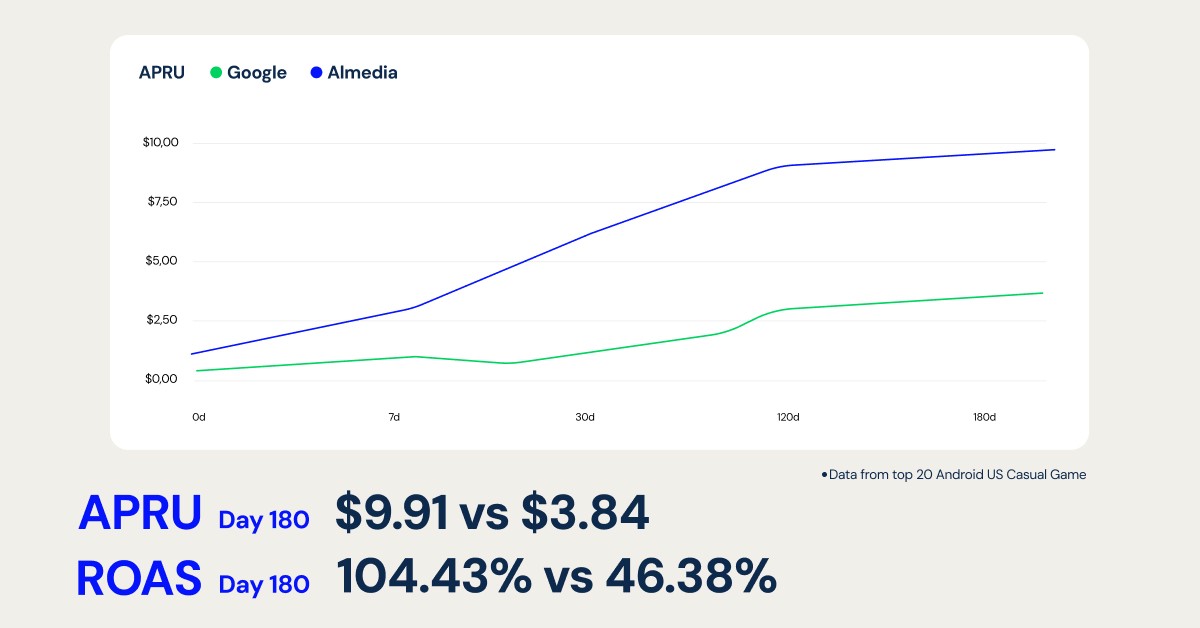
In 2026, we expect rewarded to continue its takeover of ad budgets and market share, and with its ability to double ROAS and increase retention and LTV compared to alternative channels, it’s easy to see why. We compared rewarded users from Almedia to Google users for a top mobile game, and the results were stark. The rewarded users outperformed traditional in their D180 ROAS (104.43% vs 46.38%) and D180 ARPU ($9.91 vs $3.84), an enormous difference in quality when scaling.

With 82% of UA managers in the US and UK reporting that reward-based campaigns outperform traditional marketing efforts, developers and publishers who don’t embrace rewarded UA will be left behind.
Only the Strongest Will Survive
Companies starting in rewarded UA a few years ago had a much easier time of things compared to how challenging it’ll be in 2026. The industry is maturing, and with it, the approach to delivering results.
In 2026, the rewarded UA ecosystem will go through consolidation, similar to how DSPs and ad networks did in the past. Smaller reward platforms will merge, be acquired, or disappear, and larger companies will strengthen their positions by absorbing these platforms.
For example, we expect companies such as AppLovin to acquire rewarded-oriented platforms to create stronger synergies around their products, similar to how Unity acquired Tapjoy.
At the same time, with the rewarded UA industry shifting heavily towards a data-driven model, companies that better leverage granular data will gain a significant advantage over those who are comfortable with their current position. These changes will reshape the structure of rewarded UA and influence the strategies used by advertisers.
We’ll see performance gaps widen, with the current field of 5-6 major platforms consolidating into 1-2 clear leaders. These leaders will be the ones using sophisticated optimization, tailored pricing models, and data-backed targeting, differentiating themselves from the rest with:
Improved user and reward matching
Sophisticated pricing at the user level rather than flat CPI by country/OS
Strong product quality to sustain UA success
Rewarded UA is still young. Few companies in the sector possess mature datasets. Early-mover advantage favors established companies with optimized UA and large user bases. With these barriers to entry consistently rising, new entrants without substantial budgets face near-impossible odds to achieve profitability against existing players.
Traditional channels will also act as an accelerant. The more they increase margins at the cost of advertiser profitability, the more advertisers will move their budgets towards rewarded channels.
D360 Will be a Meaningful Metric
At the tail-end of 2025, a lot of rewarded campaigns are set up with simple targets, and the KPIs are defined with CPI per country/OS, focusing on reaching ROAS targets.
We expect this approach to evolve to offer more advanced targeting and bidding options, with rewarded platforms offering tROAS bidding similar to how Google Ads already enables advertisers to focus on reaching a specific target ROAS rather than simply CPI or CPA. Furthermore, bidding options will diversify, enabling sophisticated pricing at the user or target group level.
This means advertisers are measuring true success not by the volume of installs, but on post-install value. Rewarded platforms, which already offer these metrics, will double down on delivering them, and delivering them in a more targeted and tailored way.
Thus, transparent data exchange between vendors and advertisers will become even more important, from the start of campaigns onward. In fact, the data exchange period will have to be extended significantly so rewarded UA platforms can draw more meaningful conclusions beyond D180 and even D360.

Advertisers Will Want Even More, but the Best Will Think Long-Term
Under the context of more sophisticated measurement, and the growth of rewarded as a vertical, advertisers will expect more from rewarded UA channels in 2026.
Many advertisers already aim to reach 100% ROAS before the rewarded window ends, perceiving spend as wasted if this is not achieved. This is most common with smaller studios, as they are more anxious about cashflow, with a lower tolerance for perceived wasted spend. Smaller studios require predictable recovery, whilst large, more established ones are more patient with delayed payback.
Expectations will increase across the market, and it is up to rewarded UA platforms to deliver better LTV and emphasize the true value of the users delivered.
With post-reward automations and progress in personalization across creatives and rewards, we will see more sustained engagement, which will encourage more advertisers to accept longer payback periods.
The Non-Gaming Floodgates Will Open
Rewarded UA has performed well in mobile gaming since its inception, and 2025 has been no different. With the accepted structure of mobile games, with levels, bonus points, and optimization towards regular purchases, building reward funnels was a natural development.
However, with the mobile gaming sector consolidated, we anticipate 2026 to be the year when non-gaming starts to show its potential within rewarded UA. We have already seen the likes of retail, finance, education, iGaming, and even healthcare/fitness begin to take steps into rewarded to varying degrees.
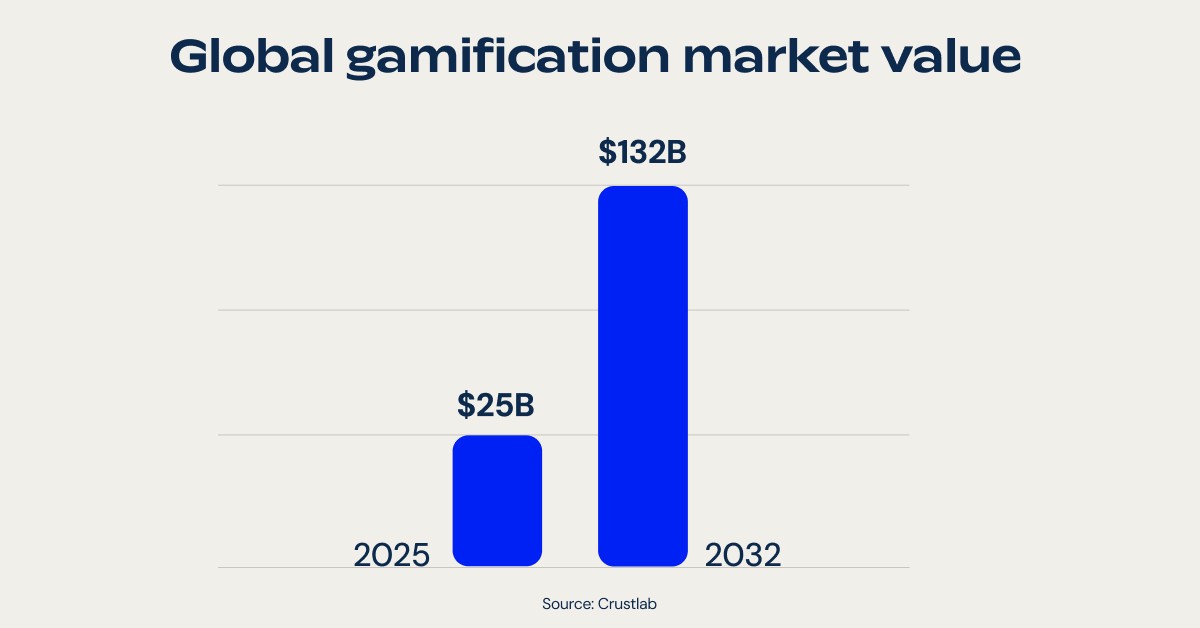
The global gamification market is valued at around $25.94 billion, with projected growth to over $132 billion by 2032. With this growth, UA for gamified apps will have to incorporate rewarded UA more in their channel mix due to the strong fit and proven success of the rewarded model.
We’ll probably see the swiftest growth in adoption from fintech, as we’ve already seen its use on rewarded platforms. Technical readiness for rewarded UA is limited across the sector, leaving room for enablement and partnerships with service providers.
The maturity and LTV-focused future of rewarded UA is the key for fintechs to adopt the strategy further in 2026. Simply growing in volume isn’t enough. Amid falling CPIs, higher IPMs, and stronger CTRs, app marketers are targeting higher-quality, more loyal users according to Adjust.
Rewarded mechanics within fintech apps will play a huge part in acquiring and retaining better users, and the mature rewarded sector will lend its expertise to fintech in order to achieve this in 2026 and beyond.

Devs Who Don’t Design Around Rewarded UA Will be Left Behind
Designing games with rewarded flows in mind will take off in 2026, and developers who do this to greater effect will see the most success. This phenomenon has been growing for a couple of years now, but the tech and products in rewarded are at the level required to take advantage of specifically-designed events folding UA into gameplay.
Rewarded UA has moved beyond D7 and D30, offering flows up to D90, and many games lack the truly deep events that would engage users and encourage spending past D60. The integration of more and better events that utilize the rewarded flow will make games more optimized for monetization with more natural user progression, and will also speed up onboarding and flow creation.
We anticipate that in the future, rewarded platforms will be consulted as part of the game design process, to ensure maximum synergy as rewarded UA becomes an unmissable important aspect of app and game advertising.
Rewarded’s Advantage Will Grow Even Further Thanks to Data Constraints
In the post-IDFA era, privacy is the concern of advertisers everywhere, in every vertical. 2026 will see rewarded UA widen its competitive advantage thanks to the lack of reliance on third-party targeting.
Rewarded UA benefits from first-party data, thanks to the value-exchange leading to opt-in from users, rather than heavy tracking. Therefore, it is more resilient to further restrictions on identifiers, cookies, and third-party data.
With first-party data enabling more precise audience targeting, rewarded will use this as an advantage under privacy constraints. These restrictions aren’t stopping, either. Categories like iGaming are reportedly unable to advertise on Google anymore, resulting in more opportunity to capture relevant audiences.
Traditional advertising’s costs are more volatile than ever, too. Business of Apps shows mobile app CPIs ranging from $0.80 to $5+, with gaming CPIs between $2 to $6+, varying strongly by OS, region, and channel. With UA being a major, unpredictable rising cost line, the first-party data availability from the rewarded sector will provide much-needed stability in UA.
Literal Gold Bars as Rewards
Rewarded UA is always being further and further integrated into everyday life. In the coming year, we expect to see reward variety expanding outside of simple reward applications.
We’ll see rewarded mechanisms appear more in daily transactions and integrated with ordinary consumer behavior, creating an environment where rewards are part of daily routines.
In 2026, we’ll be seeing alternative asset-based rewards. Crypto is already a cashout option on rewarded platforms like Freecash, but we’ve been seeing reports from South Korea that point to some really cool potential developments in the rewarded space.
Apparently, gold bars have become a top-selling item in convenience stores, marketed in small, giftable units. It’s easy to imagine that in a world in which the rewards from the likes of Freecash are backed by the gold standard, it further legitimizes the vertical.
Of course, it’s not all about rewarded UA being quite literally worth its weight in gold, but this is a great example of the potential for rewards to cross over to the physical world.

Failing to Embrace AI Hyperpersonalization Will Separate Winners From Losers
Creatives will continue to be one of the strongest drivers of UA performance, and AI-generated content will become even more advanced. However, users still recognize the difference between AI and human-created visuals, and in some regions, AI-generated content is not welcomed and can harm campaign performance.
For this reason, we expect to see a combined approach in which AI is used for rapid production and variation testing, while human creative direction ensures authenticity, emotional impact, and cultural agency, balancing efficiency and results. This is already being used by forward-thinking agencies to increase volume and variation of ad creatives, and technology is getting to the point where AI can generate and select personalized ads.
Investment in AI and automation will allow the industry to hyperpersonalize more than just creatives. Rewards will be tailored as well, with AI and ML models picking the right segment for the right user at the right time.
AI and automation will allow rewards and events to be fully personalized for each individual, with every user receiving different missions, incentives, and value propositions based on their behavior, preferences, and historical data.
We already see an early version of this in financial platforms that personalize rewards based on a user’s financial background. Over the coming year, we expect to see this approach expand into the reward ecosystem and create a future where each user experiences a unique reward path that maximizes their engagement and likelihood to convert.
Conclusion
Rewarded UA has transitioned from early innovation to an industry inevitability, and it’s now entering its most exciting phase.
With AI-driven hyperpersonalization, first-party data advantages, cross-vertical expansion, and more, the rewarded ecosystem of 2026 will look radically different from the one we knew even one year ago. What started as a promising channel is now the backbone of modern UA.
If you’re ready to be a part of this next generation of rewarded performance, connect with Almedia and let’s build a strategy that lasts.